
Criminal Court Records in Hinds County
A Hinds County criminal court record is the official case file a court clerk builds once a prosecutor files charges. It is a running history of the case. The file holds the charging instrument, arraignment entries, motions, pleas, trial settings, verdicts, dispositions, sentencing orders, probation terms, restitution, fines, and any capias or bench-warrant flags. This is the case-level record. It is not the same as the booking entry the jail creates at arrest. The booking sheet shows charges as the officer logged them. The court file shows what the prosecutor actually charged and how a judge resolved it. For the charges themselves, see the Hinds County arrest and court charge records.
Several courts hear criminal matters here, and the level decides where the file lives. Circuit Court is the primary felony trial court for serious crimes, indictments, and appeals from lower courts. County Court and Justice Court handle misdemeanors, initial appearances, preliminary hearings, and bind-over activity that sends a felony up to Circuit Court. Municipal courts in Jackson, Clinton, and other cities handle city misdemeanor and ordinance cases. Because Hinds County splits between a Jackson district and a Raymond district, the same court level can sit at two addresses. The clerk for each court keeps that court's criminal files.
How to Search Hinds County Criminal Court Records
There is no single search box for every criminal case. Felony and County Court cases route through Mississippi Electronic Courts, the statewide case system known as MEC. Hinds County belongs to the Seventh Circuit Court District for circuit and county matters. The Seventh Circuit MEC court information page lists the local court locations and the case flags used in the system. County Court criminal filings moved to MEC starting January 1, 2016, while circuit filings went electronic in 2013.
- Identify the court. Felonies point to Circuit Court; misdemeanors and preliminary matters may sit in County Court, Justice Court, or a municipal court.
- Open the Mississippi Electronic Courts system or the Seventh Circuit MEC page and confirm the district and venue.
- Search by defendant name or case number, then narrow by court, case type, and filing date.
- Open the case to read the docket entries, charges, plea, disposition, and sentence.
- Request a certified copy from the Circuit Clerk when you need a court-accepted document.
Public viewing of MEC documents may require a public-access account and per-page fees. PAMEC, the public-access arm of the system, can be reached at P.O. Box 117, Jackson, MS 39205, or 601-576-4650. For older files, sealed-status questions, or anything not online, the clerk counter is the fallback. The county also publishes a public records request channel for records the courts do not post.
Stages of a Hinds County Criminal Case
A criminal case moves through a set order of steps, and each step leaves its own mark on the record. Reading the docket in order tells the story of the case. The flow runs like this:
Case flow: Charges Filed › Arraignment › Pretrial / Motions › Plea or Trial › Disposition › Sentencing
- Charges Filed
- A prosecutor files a charging document. For a felony this is usually a grand jury indictment; for some cases it is an information. The case number and case type are set here.
- Arraignment
- The defendant is formally told the charges and enters a plea. The docket may show an Arraignment Pending flag until this hearing happens.
- Pretrial and Motions
- Lawyers file written requests for orders, exchange evidence, and argue legal points. Continuances, bond changes, and counsel appointments show up in this stretch.
- Plea or Trial
- Most cases end in a plea. Others go to a bench or jury trial that produces a verdict. Either path leads to a disposition.
- Sentencing
- After a conviction the judge imposes punishment. The order can list jail or prison time, probation, restitution, fines, and court costs.
Reading Hinds County MEC Criminal Flags
Mississippi Electronic Courts marks each case with short status flags, and the Seventh Circuit set used in Hinds County is unusually plain about where a criminal case stands. These tags act like a quick status line on the docket. Knowing the common ones lets a reader judge a case at a glance without opening every filing.
- Arraignment Pending and BOUND OVER, which show the case is early or was sent up from a lower court.
- Capias Pending and Bench Warrant Issued or Bench Warrant Returned, which flag arrest or appearance orders.
- MDOC Warrant Issued, which points to a state corrections hold.
- Conviction Order TBE and Misdemeanor Order TBE, which mean an order is to be entered.
- EXPUNGED, which signals the case has been cleared from public view by court order.
Warrant-type flags matter most to readers checking their own status. A Capias Pending or Bench Warrant Issued tag is a sign to act, and the issuing court or sheriff can confirm whether the order is still live. Note: MEC flags reflect court workflow only and should be confirmed with the clerk before anyone relies on them for a legal step.
What a Hinds County Criminal Court Record Shows
A criminal case file is built from standard fields, and the same fields appear across courts even when the layout differs. In a criminal matter the parties are listed as the State of Mississippi against the named defendant. The fields below cover what a typical file holds once a case is underway.
| Field | What It Shows |
|---|---|
| Case Number | The court-specific identifier; older county forms used a two-digit year plus a six-digit number. |
| Court and District | The trial court and whether the case sits in the Jackson or Raymond district. |
| Defendant | The accused person; the State of Mississippi is the charging party. |
| Charges | Charge name, the felony or misdemeanor level, indictment number, and arresting agency. |
| Plea | The defendant's formal answer, such as guilty, not guilty, or no contest. |
| Docket Entries | The dated log of every filing, hearing, motion, and order in the case. |
| Disposition | The final outcome of each charge, from dismissal to conviction. |
| Sentence | Any prison or jail term, probation, restitution, fines, and court costs. |
Some fields are redacted even in a public file. Social Security numbers, financial account numbers, sealed filings, and minor names are commonly removed. For a broader look at every record type a court keeps, the Hinds County court records overview covers civil, family, and probate files alongside criminal ones.
Reading Dispositions and Sentences
The disposition is the heart of the record. It states how each charge ended. One case can carry several charges, and each can end in a different way. A reader should check the disposition for every count, not just the lead charge, because a case can show both a dropped count and a conviction. Common dispositions in Hinds County criminal files include:
- Guilty plea or guilty verdict, which becomes a conviction.
- Not guilty, which is an acquittal at trial.
- Dismissed or nolle prosequi, where the prosecutor drops the charge.
- Nonadjudicated, retired, or remanded, which are conditional or held outcomes.
- No contest, where the defendant does not fight the charge.
The sentence sits in the order that follows a conviction. It may set a term in county jail or in state prison under the Mississippi Department of Corrections, plus probation, restitution to a victim, fines, and court costs. A Conviction Order to be entered flag can appear while the written order is still being filed. Read the sentence with the disposition together, since punishment only attaches to a charge that ended in a conviction.
Charges vs. Convictions
Being charged is not the same as being convicted. A criminal court record can show charges that were later dropped, dismissed, or that ended in acquittal. A charge is an accusation. A conviction is a finding or plea that establishes guilt. The file keeps both, so a careful reader separates the accusation from the result.
| Charge | Conviction | |
|---|---|---|
| Stage | Accusation at filing | Verdict or plea |
| Burden of Proof | Probable cause | Beyond a reasonable doubt |
| Can Be Dropped | Yes, by dismissal or nolle prosequi | No, only appealed or vacated |
| Public Record | Yes | Yes |
Who Files the Charges in Hinds County
The record starts with a charging decision, and a prosecutor makes it. In Hinds County, felony prosecutions run through the district attorney for the circuit district. The district attorney presents cases to a grand jury, secures indictments, appears in Circuit Court, and decides what charge to file, reduce, dismiss, or take to trial. County, municipal, and lower-court prosecutors handle misdemeanor and city cases. The arrest charge an officer logs at the jail is not the final charge. The prosecutor's filing is what sets the case file in motion, which is why the booking sheet and the court record can differ.
State charges are separate from federal ones. A person arrested by the Hinds County Sheriff is not automatically in federal court. Federal crimes are prosecuted by the United States Attorney, and the U.S. Attorney's Office for the Southern District of Mississippi handles those cases out of Jackson rather than the county courthouse.
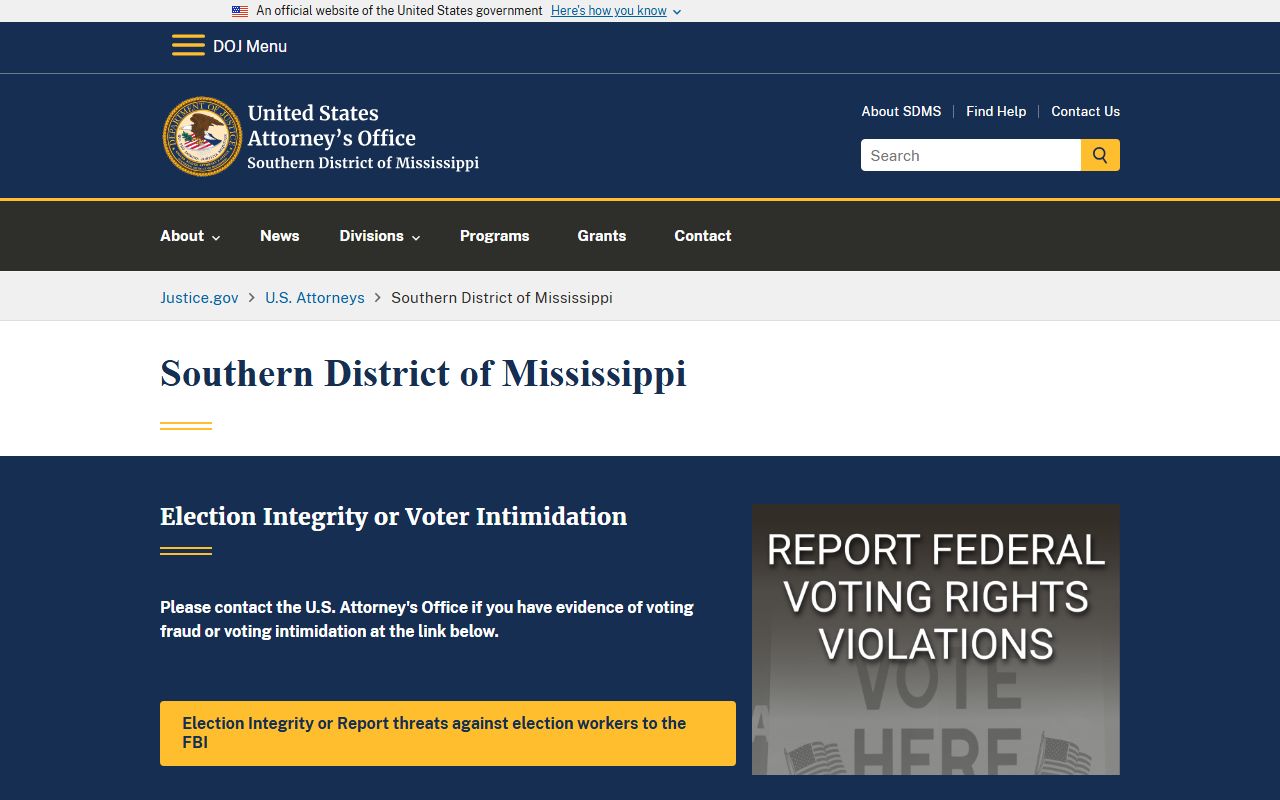
The federal office shown above prosecutes cases that never touch a Hinds County criminal court record, so a federal defendant may have no state file at all. When the state and the federal system both have an interest, two separate dockets exist, and each must be searched in the court that filed it.
Eligible defendants who cannot afford counsel receive court-appointed representation. The docket may show an Indigent flag, an appointment of counsel, plea negotiations, and the attorney of record. Those entries are part of the public case file, though some attorney work product and victim-services material stay restricted even when the final order is open.
Public Access to Hinds County Criminal Records
Adult criminal case files in Hinds County are public records. Access depends on whether the record is a court file, a jail booking entry, or a confidential category. Judicial records should be searched in MEC or requested from the clerk, because courts keep case files apart from general county departments. Jail data viewed through the inmate portal is current-arrest information only and is not a conviction record. The statutes below set the access framework.
Key Statutes:
Miss. Code Ann. Title 25, Chapter 61 - The Mississippi Public Records Act requires public bodies to provide access to public records unless a specific exemption applies.
Miss. Code Ann. § 99-19-71 - Defines the categories of Mississippi convictions and nonconviction records that may be expunged when statutory conditions are met.
Miss. Code Ann. § 43-21-261 - Keeps youth court records confidential so juvenile matters do not appear like ordinary adult criminal dockets.
Sealed vs. Expunged Records
Two terms cover record removal, and they are not the same. A sealed record is hidden from public search but still exists. An expunged record is treated as if it never happened, and the EXPUNGED flag is what shows in MEC when a Hinds County case has been cleared. Mississippi expunction is a petition-based process under Section 99-19-71, and eligibility turns on the offense, the disposition, prior record, and a waiting period.
| Sealed | Expunged | |
|---|---|---|
| Visibility | Hidden from public view | Removed and treated as never existing |
| Law Enforcement | Limited access retained | Very limited internal retention |
| How It Happens | Court order or confidential category | Petition granted under § 99-19-71 |
| Eligibility | Juvenile, sealed, or sensitive filings | Eligible dismissals and certain convictions |
Because Hinds County runs several courts, one event can leave records in more than one place. An arrest in the jail portal, a charge in Justice or Municipal Court, and a felony case in Circuit Court may each need a separate custodian to update after an order. A petitioner files in the proper court, pays the filing fee unless it is waived, notifies the required prosecutors and agencies, and waits for the judge's order. If relief is granted, the clerk, law enforcement, and record repositories receive the order and remove the matter from public search.
Background Check Considerations
A casual case lookup is not a background check. A formal background check for employment, housing, or licensing must follow the Fair Credit Reporting Act and use a regulated screening company. Court files can be incomplete, can lag behind recent orders, and can omit cases that were expunged or sealed. Treat any single search as a starting point and confirm a result with the clerk before acting on it.
Important: This site is not a consumer reporting agency under the FCRA, and its information may not be used for credit, employment, tenant, insurance, or other regulated screening.
Restricted Hinds County Criminal Court Records
Not every criminal matter is open to the public. Youth Court records are the clearest restricted category, and Mississippi youth court confidentiality law keeps juvenile delinquency, neglect, and abuse files out of ordinary case searches. County Court runs the youth court function in Hinds County, so those matters never appear like adult dockets. Sealed and expunged cases either drop from public search or show only a limited status.
Mental health and drug commitments involving minors are sensitive tracks handled in the chancery and youth systems, and public document access should not be assumed. Even in an open file, personal identifiers such as Social Security numbers, financial account numbers, and minor names may be redacted. Ongoing matters and sealed warrants can also be withheld. When a record does not appear, the right step is to ask the clerk for the issuing court and the record's status rather than assume no case exists.